
Book Project: Networked People Power: Digital Rhetoric & Nonviolent Resistance on Social Media
(The Ohio State University Press New Directions in Rhetoric and Materiality series)

As a historical driver of social movements and cultural change, nonviolent resistance is experiencing an evolution of sorts in contemporary social media environments. Social media advocacy is all around us, but appears in especially evocative instances in social movements where users are reimagining nonviolent resistance in forms that take advantage of the logics, habits, practices, and affordances of the internet. For instance, users on social media are posting self-portraits without headscarves to protest mandatory hijab laws (reimagining civil disobedience), disrupting events from prominent politicians in viral Instagram videos to push for climate change policies (reimagining disruption), “going dark” in reddit’s biggest communities to protest COVID misinformation (reimagining strike), hatefully resisting “woke” corporations in the anti-transgender Bud Light boycott (reimagining boycott), and “checking in” on Facebook to resist the Dakota Access Pipeline (reimagining occupation of contested space). Social media users are even inventing new forms of nonviolent resistance that don’t have clear historical parallels, as the participatory investing practices of the r/WallStreetBets community demonstrate in their coordinated purchasing of GameStop stock to pursue a form of economic justice.
Networked People Power: Digital Rhetoric and Nonviolent Resistance on Social Media is a book that connects two seemingly disparate topics—nonviolent resistance and social media—through a shared locus of digital and material rhetoric. Networked People Power’s core argument is that grassroots networks of ordinary users on social media are leveraging digital rhetoric to reimagine tactics of nonviolent resistance—like noncooperation, strikes, disruption, and civil disobedience—to engage in advocacy and pursue social justice in forms that are of interest to scholars of rhetoric, digital culture, and writing. The book’s purpose is to expand how rhetoric scholars and the public understand nonviolent resistance on social media to be a driver of social change, digital advocacy, and social movements. As an illuminating schema, digital rhetoric helps to shed light on the characteristics, aptitudes, and constraints of nonviolent resistance on social media. The book contributes to the field of rhetoric’s long-standing emphasis on explicating social movements by considering digital rhetoric, nonviolent resistance, and social media together, examining movements that combine the three to examine how they form, delineate how they express their goals and messages, and scrutinize their efficacy for enacting change in the world through both symbolic and material means.
At its core, this book contributes a rhetorical approach to digital nonviolent resistance on social media. It considers how social media users are reimagining many of the strategies employed historically for achieving social change while also introducing new logics, habits, practices, and technocultures that are organic to the internet. By coupling evocative digital rhetorics with the kairotic leverage attained through nonviolent resistance tactics like noncooperation, disruption, strikes, and civil disobedience, social media advocates have materially enacted social change while also encountering numerous constraints and limits to their advocacy. In its five chapters, Networked People Power argues that core concepts of digital rhetoric— digital rhetorical invention, circulation, digital writing, labor, participation, and kairos, respectively—illuminate how social media communities leverage nonviolent resistance tactics to enact meaningful social change in their communities. Networked People Power argues that nonviolent resistance on social media is a mode of digital-material rhetoric that is capable of pursuing social justice, stimulating social change, and generating impactful material interventions in the world that improve people’s lives and circumstances.
Original Contribution
Networked People Power’s core original contribution offers readers a rhetorical approach to digital nonviolent resistance on social media that is developed through a collection of illustrative case studies examining digital nonviolent resistance’s utility for pursuing social change and social justice. The book is an original contribution to the field of rhetoric and composition studies, though it builds on and synthesizes scholarship from four core disciplinary discussions: (a) digital rhetoric, (b) social movement rhetorics, (c) nonviolent resistance’s discursive and material connections to rhetoric, and (d) social media. By building on the four ongoing disciplinary discussions identified above, which have to my knowledge never been connected in an academic monograph (or any related genre), the book is able to develop a digital rhetoric-informed understanding of nonviolent resistance through examination of social movements by examining their characteristics, aptitudes, and constraints. These social movements include coordinated “blackouts” on reddit to protest COVID-19 misinformation and digital labor standards (reimagining strike), hashtag activism in #MyNYPD (reimagining noncooperation), the #NoDAPL movement (reimagining occupation of contested space), the r/WallStreetBets participatory investing movement (which does not have clear historical precedent), and Climate Defiance’s viral advocacy videos that disrupt events from prominent political leaders to demand environmental policy changes (reimagining disruption).
As a contribution to the study of rhetoric, writing, communication, and the internet, this book offers an inquiry into digital nonviolent resistance in social media writing communities that foregrounds attention to digital rhetoric as an illuminating schema. It considers how traditional offline tactics like civil disobedience (Ch. 1 & Ch. 2), noncooperation (Ch. 3), occupation of contested space (Ch. 3), boycotts (Ch. 2), strikes (Ch. 4), and disruption (Ch. 1 & Ch. 2) are reimagined for the technocultures, affordances, and rhetorical situations organic to social media. Accordingly, the project draws on digital rhetoric to illuminate this reimagination, drawing on disciplinary theories and histories of digital rhetorical invention, circulation, digital writing, labor, participation, and kairos. Drawing on New Materialist and ontological theories of rhetoric, the book additionally argues that these nonviolent resistance tactics function as rhetorical strategies, contributing to how scholars understand digital rhetoric, rhetorical theory, social movement rhetoric, and social media. In this sense, the book builds a highly original argument from a series of interconnected disciplinary discussions that have lots of momentum in rhetoric studies, orienting these conceptual threads toward opportunities for rhetoric, social media, and nonviolent resistance to contribute to movements for social justice.
The gap in the scholarly literature that this book aims for is simultaneously both wide and narrow: while much as been written about digital rhetoric, social media, advocacy rhetorics, and nonviolent resistance, few books or articles have written about them all together. Moreover, none have been written in rhetoric and composition studies or with the calibration toward rhetoric that this book articulates.
Book Organization & Chapter Overview
Preface: Networked People Power
This short Preface introduces the exigence for the book, considers its genesis and starting points, and introduces the material, ethical, and moral opportunities offered by a rhetorical approach to digital nonviolent resistance in social media environments. The Preface also introduces research questions that orient this book’s inquiry such as “How do digital advocacy texts on social media impact people’s material circumstances?” and “[do] advocacy texts circulating on social media have fundamental shortcomings when attempting to generate material change in the world?”
Introduction: What Digital Rhetoric Brings to Nonviolent Resistance
The book begins with an Introduction chapter that defines what digital nonviolent resistance on social media is while also examining its historical, offline, and online precedents. This chapter theorizes what rhetorical theory and digital rhetoric in particular bring to the study of nonviolent resistance on social media. The Introduction introduces and defines key terms like digital nonviolent resistance and theorizes how nonviolent resistance strategies can function as rhetorical strategies within a given context. It then offers readers a chapter-by-chapter overview of the rest of the book, explains what the book is and what it is not, and discusses some of the opportunities and challenges digital nonviolent resistance brings to movements for social justice that the rest of the book will conceptualize. Overall, the Introduction introduces the book’s core argument that users on social media are leveraging digital rhetoric to reimagine tactics of nonviolent resistance—like noncooperation, strikes, disruption, and civil disobedience—to engage in advocacy and pursue social justice in forms that are of interest to scholars of rhetoric, digital culture, and writing. It culminates by introducing the book’s central assertion: that nonviolent resistance on social media is a mode of digital-material rhetoric capable of pursuing social justice, stimulating social change, and generating impactful material interventions in the world that improve people’s lives and circumstances.
Ch. 1- Rhetorical Invention as Digital Civil Resistance
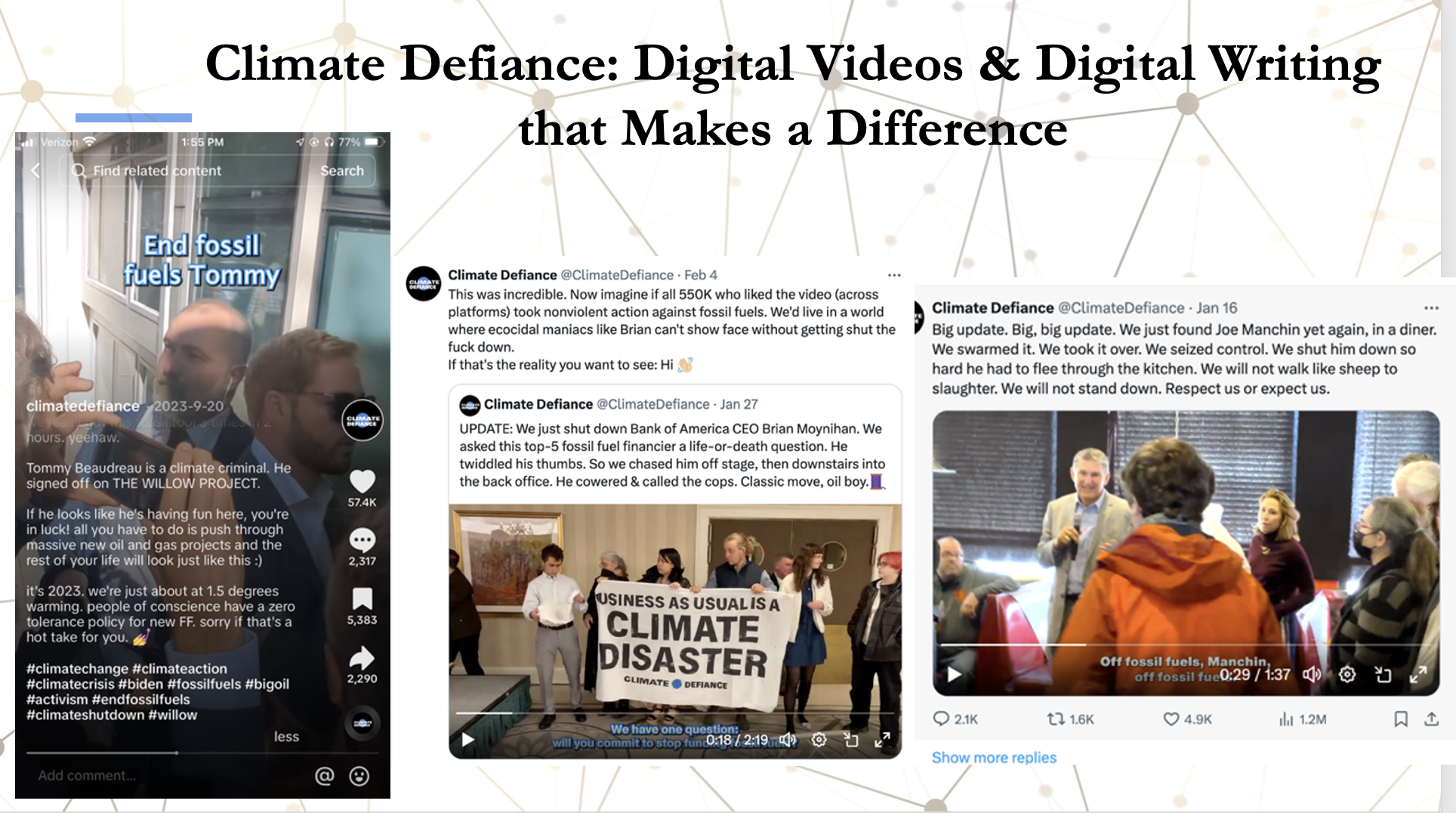
Ch. 1 develops a rhetorical understanding of digital nonviolent resistance by examining a case study involving the tactics of disruption, civil resistance, and civil disobedience that are prominently used by an environmental advocacy organization on social media. The chapter develops this contribution by examining how an advocacy group, the US-based environmental organization Climate Defiance, has crafted an innovative form of digital rhetorical invention to pressure the Biden administration on issues related to climate change, oil drilling, and climate policy. Titled “Rhetorical Invention as Digital Civil Resistance,” the chapter examines how Climate Defiance’s rhetorical invention efforts are able to alter the environmental status quo in the United States and beyond by pressuring the Biden administration with disruptive civil disobedience actions oriented for viral circulation on social media. Founded in 2023, the group’s bio on Twitter/X identifies them as a “brand-new, youth-led group using direct action to resist fossil fuels” while their cross-platform social media presence (Twitter/X, Instagram, TikTok) has earned as many as 989k views on just one single viral post. As an advocacy organization explicitly calibrated for a social media rhetorical environment, Climate Defiance enacts pressure campaigns on political and business leaders by disrupting their public events and then widely circulating the resulting dramatic, shocking, provocative, and confrontational videos on social media. Climate Defiance’s digital rhetorical invention strategy, which enacts civil disobedience through the tactic of disruption, is aimed primarily toward circulating viral videos of the group’s dramatic disruption of public events. Climate Defiance and related organizations like the Sunrise Movement have devised social media-centered tactics to disrupt public events with figures like Kamala Harris, Federal Reserve Chair Jerome Powell, Bank of America CEO Brian Moynihan, former General and CIA director David Petraeus, Deputy National Climate Advisor Mary Frances Repko, and a delegation from the American Petroleum Institute. Most of their social media texts feature video of Climate Defiance protesters disrupting these public events and confronting these leaders directly about their culpability for the climate crisis. Additionally, they also leverage algorithmic video distribution systems to circulate highly charged digital writing that is crucial for the material success of the text. In these social media texts, Climate Defiance crafts what John W. Delicath and Kevin Michael DeLuca call “image events” that are calibrated for social media audiences, for algorithmic circulation, for shock value, and for nonviolent resistance enacted in digital networks (315). The chapter closes by theorizing how digital civil disobedience on social media differs from fully offline civil disobedience, by considering what this illustrative case brings to how rhetoricians understand rhetorical invention, and by considering the surprising material impacts these instances of digital nonviolent resistance have had on US climate policy specifically related to pipeline construction and approval of natural gas export terminals during the Biden administration. This closing note in the chapter introduces the concepts of rhetorical consequences and meaning consequentialism that the next chapter will build on in its theorization of rhetorical actantcy.

Ch. 2- Nonviolent Resistance in Social Media Video
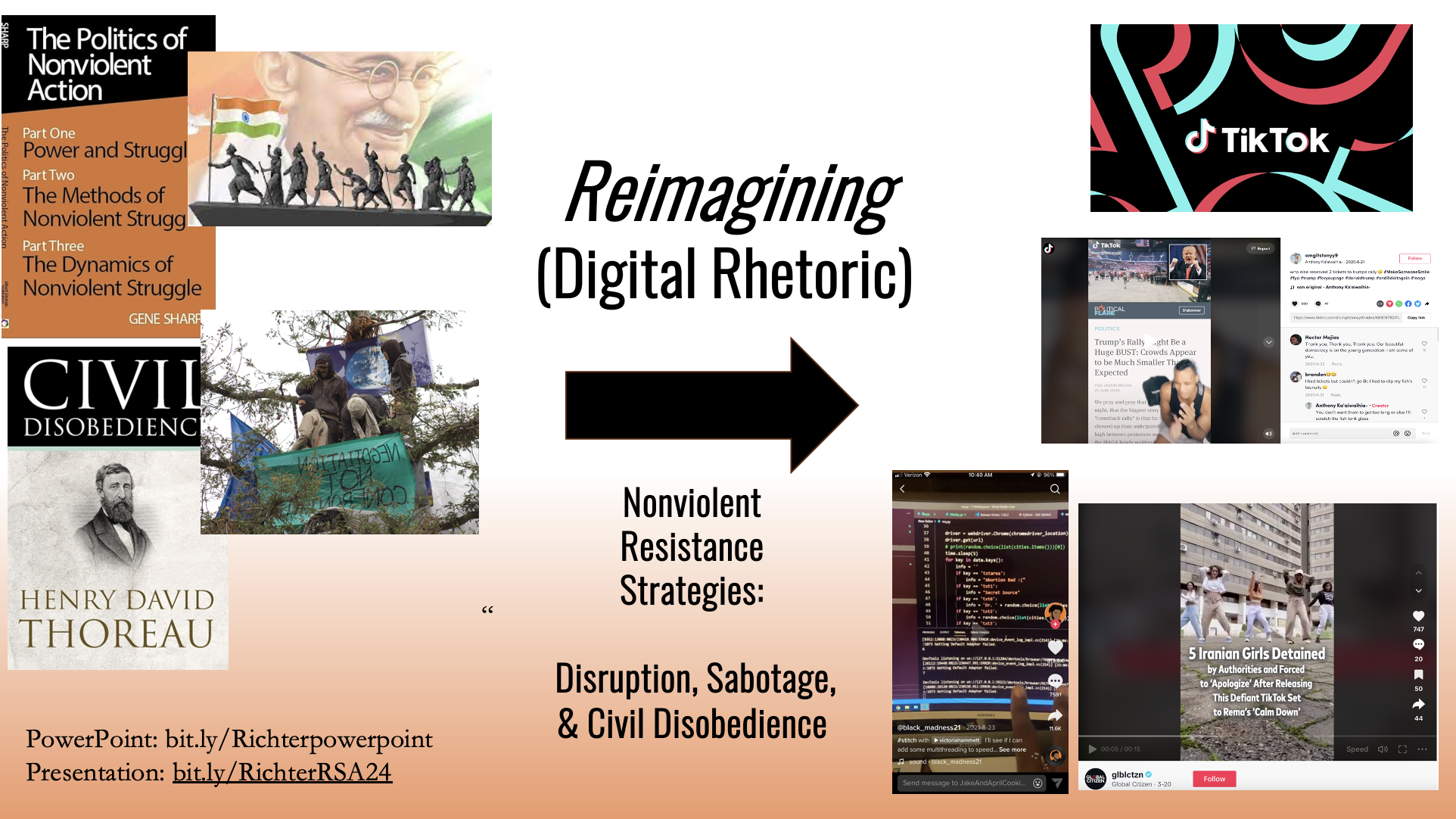
Ch. 2, titled “Nonviolent Resistance in Social Media Video,” argues that nonviolent resistance calibrated for social media video platforms like TikTok, Instagram Reels, and YouTube Shorts have demonstrated efficacy in achieving important social changes. Building on Ch. 1’s development of digital nonviolent resistance, this chapter more formally connects this theory to materiality by focusing on the connections between digital texts and felt material impacts on people’s lives through discussion of two concepts from New Materialist approaches to rhetoric: Laurie Gries’ concept of the “rhetorical consequence” (Still Life 109) and Kevin Porter’s concept of “meaning consequentialism” (12). Building on these theories, the chapter argues that acts of digital advocacy only become materially impactful when they transition from being intermediaries to roles as mediators that “transform” or “modify” an evolving situation, to borrow terminology from Bruno Latour’s Reassembling the Social (39). Thus, in a New Materialist approach to digital advocacy rhetorics, becoming a mediator and enacting what Jane Bennett calls thing-power to generate rhetorical consequences becomes the difference between slacktivism and materially consequential activism, offering the chapter an important argument for digital-material rhetorics to strive toward enacting in future campaigns. The chapter ties these different theoretical contributors together to develop what it calls rhetorical actantcy, the rhetorical generation of actual change, actual consequences, and actual impacts within an assemblage to catalyze spatial and temporal reorganization of matter as well as alter the human-nonhuman systems that govern collective life on variously modest and major scales. While actantcy has been theorized by rhetorical scholars in the past, this chapter’s approach foregrounds consequentiality and the material generation of changes stemming from a rhetorical thing’s interactions, tracing this rhetorical actantcy in relation to digital texts that advocate for both social justice and hate.
To showcase these theories, Ch. 2 traces four illustrative cases of TikTok content creators who leverage nonviolent resistance strategies to advocate for abortion access in Texas, to oppose the Donald Trump campaign in the 2020 election, to advocate for autonomy for women to control their own bodies in Iran, and to sustain a hateful anti-transgender boycott of Bud Light beer after the brand partnered with a trans content creator for a marketing initiative. This chapter draws on digital rhetoric’s contribution of circulation as well as New Materialist rhetorical theory to refute accusations of slacktivism and showcase material efficacy for digital nonviolent resistance. In Gries’ terms, the four short-form social media videos generate assemblages that “mobilize various entities into relation, help materialize change, and thus reassemble collective existence” with felt impact on people’s lives (13). Accordingly, these TikTok content creators sabotaged and de-platformed a Texas anti-abortion group’s web portal, disrupted a Trump campaign rally by requesting tickets with no intention of actually attending, recorded videos dancing in public without wearing headscarves on International Women’s Day (which breaks a legal prohibition in Iran and contributed to the Woman, Life, Freedom social movement), and made viral TikTok videos advocating for a boycott that ended up costing Bud Light its status as America’s best-selling beer. In their incorporation of sabotage, disruption, civil disobedience, and boycotting as a means of achieving leverage for their advocacy, social media video creators @black_madness21, @omgitstonyy9, @RepublicanReflections, and Iranian women enacting civil disobedience expand what a rhetoric-informed techné of digital nonviolent resistance can feature. The chapter also considers two further materially-felt elements of digital nonviolent resistance: repression, enacted both physically and algorithmically against content creators such as the women in Iran, and diffusion, represented by the chilling effect the Bud Light boycott appears to have had on other corporations rejecting representation of diverse voices in their marketing efforts for fear of being labelled “too woke” by networks of conservative users on social media.


Ch. 3- Digital Writing as Nonviolent Resistance
Chapter 3, titled “Digital Writing as Nonviolent Resistance,” examines how digital writing can enact nonviolent resistance online to help advocacy movements, including those associated with “hashtag activism” and opposition to the Dakota Access Pipeline. By considering digital writing alongside use of noncooperation and occupation of contested space on social media, the chapter considers digital nonviolent resistance’s ability to impact the public’s understanding of race, policing, environmental conservation, and Indigenous water and land rights. In its examination of hashtag activism as a mode of noncooperation in #myNYPD, Ch. 3 theorizes key similarities and differences between online and offline nonviolent resistance. The chapter also considers how digital writing in the #NoDAPL movement against the Dakota Access Pipeline helps theorize digital writing’s capacities and shortcomings for nonviolent resistance that assists social movements. To showcase digital nonviolent resistance’s capacities and especially its shortcomings, this chapter makes extensive comparisons with Civil Rights sit-ins, which enacted both noncooperation and occupation of contested space as nonviolent resistance tactics but generated very different consequences. This chapter continues to develop the concepts of rhetorical consequences, meaning consequentialism, and rhetorical actantcy from New Materialist conceptions of rhetoric, arguing that the shortcomings of #myNYPD and “checking in” on Facebook with #NoDAPL are related to their inability to generate rhetorical consequences that erode the “pillars of support” of Energy Transfer Partners (the company building the Dakota Access Pipeline), the Trump administration, or the NYPD, to use Erica Chenoweth’s term from Civil Resistance: What Everyone Needs to Know (102). Thus, their successes in energizing what Zeynep Tufekci calls a “narrative capacity” to create change are undermined by the failure to generate the necessary material-rhetorical consequences to prevent operation of the oil pipeline near indigenous lands or prevent continued abuses by the NYPD (195). Accordingly, discussion of the rhetorical consequences that advocacy campaigns using social media are and are not capable of generating helps Ch. 3 build an argument that digital campaigns should prioritize undermining key “pillars of support” if they wish to achieve desired rhetorical consequences such as preventing pipeline construction or building sufficient pressure to alter the NYPD’s status quo.
Ch. 4- Community Resistance to Platform Power
Ch. 4 traces convergence of digital rhetoric and nonviolent resistance through examination of strikes enacted by communities on the social media platform reddit. In 2021, subreddit communities and their moderation teams protested against the platform’s tolerance of rampant misinformation relating to the global COVID-19 pandemic by “going dark,” or not allowing users to see or join their subreddit communities on a temporary basis (Mehta). Later, communities would do the same to protest unpopular changes to the platform’s 3rd party API that hurt moderators and users with disabilities. Thus, in two extensive and headline generating sagas, many of the platform’s largest communities (such as r/funny, r/mildlyinteresting, r/gaming, and r/music) refused to enact vital digital labor functions in coordinated collective action that is reminiscent of a traditional labor strike. As an inquiry into digital labor in online communities, this chapter demonstrates the enormous power exercised by platforms to be massively influential in people’s lives, but also to be ripe for targeting by digital advocates employing nonviolent resistance. It also offers a case of social media activism that is highly structured, sustained, and composed of a hybrid horizontal-vertical organization, thus pushing back on criticisms of social media encouraging “armchair activism” or “slacktivism” that fails to achieve material consequences in the world. As a wholly social media-organized social movement, these subreddit strikes showcase digital nonviolent resistance to act at the intersection of digital labor, network structure, and digital rhetoric to advocate for social justice causes. Ch. 4 closes by considering the material impacts and rhetorical consequences that noncooperation with platform power, exemplified in strikes by subreddit communities, have demonstrated in reddit’s COVID-19 misinformation and labor policies. It then argues noncooperation with platform power in the form of community strikes to have immense potential for future impact, including its potential to push back against specifically digital-material exigencies such as what Shoshana Zuboff calls “surveillance capitalism,” which requires cooperation of users for its digital-material operation.
Ch. 5- Community Resistance to Economic Power
In Ch. 5, titled “Community Resistance to Economic Power,” digital rhetoric and nonviolent resistance come together in chronicling the r/WallStreetBets subreddit community’s coordinated purchasing of GameStop stock. Using participatory trading platforms like Robinhood, these social media users realized that major hedge funds had short-squeezed the stock, essentially betting against its performance. The users’ coordinated purchasing of so-called “meme stocks,” organized on reddit, YouTube, Discord, and Twitter/X in 2021, was fueled in part by a desire for economic justice in the notoriously unfair stock market, where major hedge funds routinely engage in legal market manipulation that takes advantage of small investors such as these social media users. Through their social media-coordinated short squeeze of major hedge funds, r/WallStreetBets users showcase an instance of digital nonviolent resistance that resists economic power but that doesn’t have clear parallel in prior offline nonviolent resistance techniques. In the end, Robinhood users were able to capture a nation’s attention and materially alter the activities of the stock market, showcasing digital nonviolent resistance’s power to intervene for economic justice in ways that are informed by kairos and participation, both valuable components of digital rhetoric. The r/WallStreetBets saga also showcases digital nonviolent resistance to be a mode of digital-material rhetorical action capable of striking at the heart of capitalism and unjust economic systems: the stock market.
Conclusion: Challenges & Futures for Digital Nonviolent Resistance
Networked People Power closes with a short Conclusion that examines recent forms of digital nonviolent resistance on social media that have been used to enact harm, transphobia, and bigoted consumer activism. It also offers some speculations about what digital nonviolent resistance could look like in the future and how movements can be calibrated to secure as much agency and leverage as possible for their online advocacy. Finally, the Conclusion offers parting thoughts on what the fields of digital rhetoric and rhetorical studies gain from engagement with digital nonviolent resistance and what some future opportunities, challenges, and futures may be characterized by. The Conclusion ends by returning to and expanding on the book’s core argument that nonviolent resistance on social media is a mode of digital-material rhetoric capable of pursuing social justice, stimulating social change, and generating impactful material interventions in the world that improve people’s circumstances.
 Jacob Richter