
For a thematic and chronological overview of my research, including information about my book project and about my forthcoming research, see my Research Statement. I’m also writing a book that connects digital rhetoric, nonviolent resistance, and social advocacy that is titled Networked People Power: Digital Rhetoric and Nonviolent Resistance on Social Media. The book is signed to an advance contract with The Ohio State University Press to join the New Directions in Rhetoric and Materiality series.
My Published Peer-Reviewed Journal Articles:
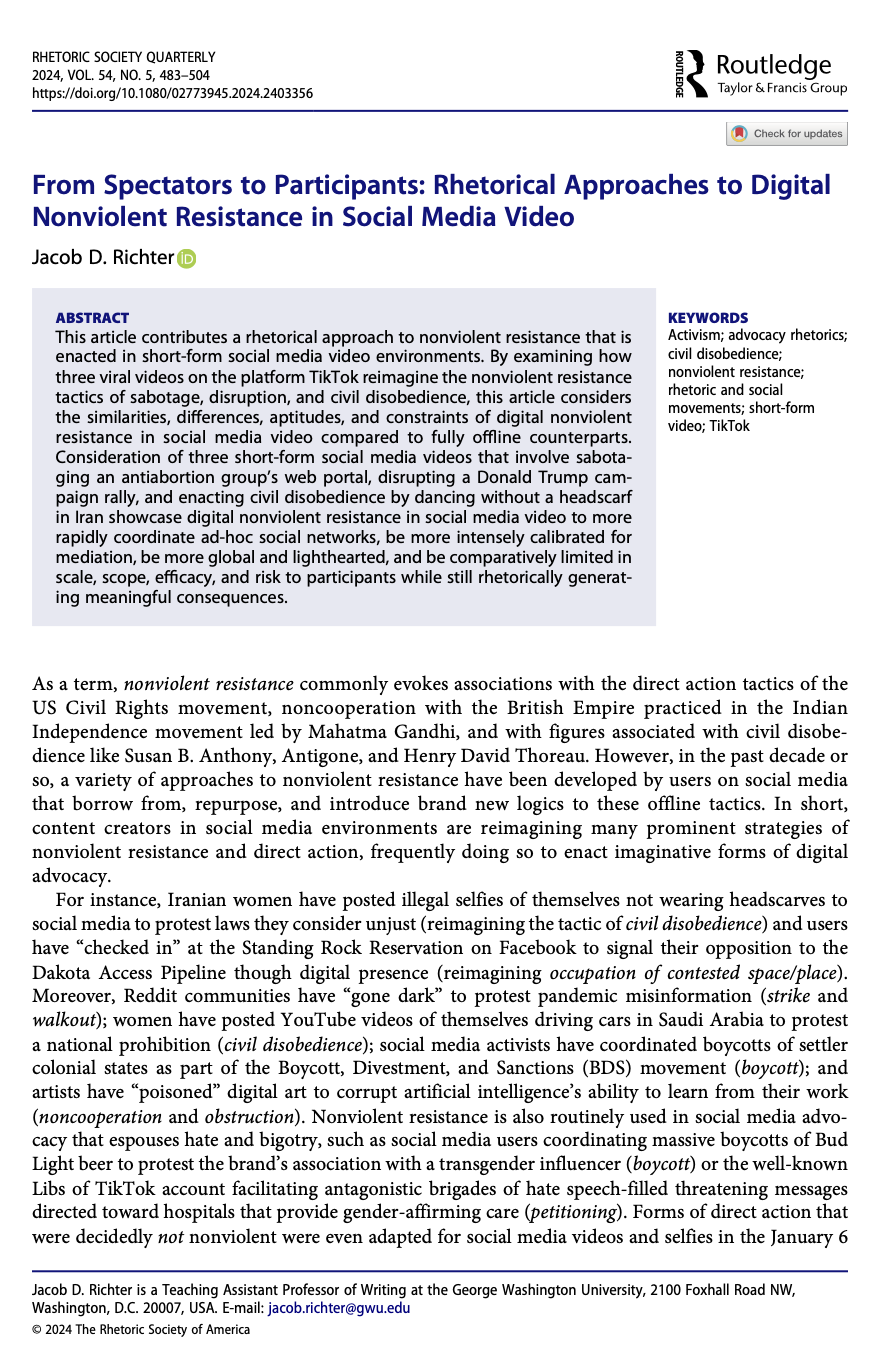
Richter, Jacob D. (2024). “From Spectators to Participants: Rhetorical Approaches to Digital Nonviolent Resistance in Social Media Video.” Rhetoric Society Quarterly. (Link).
Richter, Jacob D. (2024). “Communicating Democracy: Opportunities for Election Knowledge Communication and Voter Education in Technical Communication.” Technical Communication Quarterly. (Link).
Richter, Jacob D. (2025). “Designing Social Media Learning Environments to Promote Digital Literacy.” Communication Design Quarterly 13(3), 14-26. https://cdq.sigdoc.org/wp-content/uploads/2025/09/CDQ-13-3.pdf (Link).
Richter, Jacob D. (2024). “Nurturing Distributed Expertise with Social Media in First Year Composition Pedagogy.” Composition Forum 53. https://compositionforum.com/issue/53/distributed-expertise.php (Link).
Richter, Jacob D. (2022). “Participatory Counternarratives: Geocomposition, Public Memory, and the Sounding of Hybrid Space/Place.” College Composition and Communication (CCC), 74 (1), 113-135. (Link).
Taylor, Hannah, Richter, Jacob D., & Swartz, Haley (2024). “From the Ground Up: The Localized Labor of AI and the Political Economy of DH Perspectives in Higher Education.” The Journal of Interactive Technology and Pedagogy No. 24. https://cuny.manifoldapp.org/read/from-the-ground-up-the-localized-labor-of-ai-and-the-political-economy-of-dh-perspectives-in-higher-education/section/ef9c7ad4-ee4f-4a15-86e5-62c5ae94537e. (Link).
Richter, Jacob D. (2023). “Network-Emergent Rhetorical Invention.” Computers & Composition, Vol. 67 (1). https://doi.org/10.1016/j.compcom.2023.102758 (Link).
Richter, Jacob D. (2021). “Writing with Reddiquette: Networked Agonism and Structured Deliberation in Networked Communities.” Computers & Composition, Vol. 59, No. 1. https://doi.org/10.1016/j.compcom.2021.102627 (Link)
Frith, Jordan & Richter, Jacob (2021). “Building Participatory Counternarratives: Pedagogical Interventions in Digital Placemaking.” Convergence: The International Journal of Research Into New Media Technologies. https://doi.org/10.1177/1354856521991956 (Link)
Richter, Jacob D. (2021). “Cameraphone Composition: Documentary Filmmaking as Civic-Rhetorical Action in First Year Composition.” Xchanges: An Interdisciplinary Journal of Technical Communication, Rhetoric, and Writing Across the Curriculum, 16 (1). https://xchanges.org/cameraphone-composition-16-1 (Link)
Richter, Jacob D. (2020). “Assessing, Deliberating, Responding: An Annotated Bibliography for a Post-Truth Age.” Prompt: A Journal of Academic Writing Assignments. Vol. 4, No. 2, pp. 23-36. (Link)
Richter, Jacob D. (2020). “Inventing Networked Electracies.” Textshop Experiments, Vol. 7. (Link)
http://textshopexperiments.org/textshop07/inventing-networked-electracies.

Chapters in Edited Collections:
Richter, Jacob D. & Taylor, Hannah. (Forthcoming 2022). “Embracing Hybrid Infrastructures.” In S. Appleford, Hankins, G., and Lang, A. (Eds.), The Digital Futures of Graduate Study in the Humanities. University of Minnesota Press. Anticipated Fall 2022.
Eatman, Megan, Richardson, Sarah, Richter, Jacob D., and Taylor, Hannah. (Forthcoming). “Reconsidering Expertise: Possibilities for Distributed Expertise and Horizontal Mentoring in Writing Pedagogy Education.” In shepherd, Singletary, Macklin, Morse, and Estrem (Eds.), (Un)Commonplaces in Graduate Teaching Assistantship Training and Experiences. Forthcoming.
What I do:
–> My book project (under contract with The Ohio State University Press to join the New Directions in Rhetoric and Materiality series)
As digital technologies and practices become near ubiquitous in people’s political, academic, and social lives, considering the potential of these technologies for rhetorics of social change and for writing instruction represent exciting exigences for rhetoric scholars to pursue. My research agenda addresses these exigencies and can be broadly split into three topical pursuits: (a) research on digital rhetoric, nonviolent resistance, and social media that my book project Networked People Power: Digital Rhetoric & Nonviolent Resistance on Social Media theorizes, (b) research connected to my dissertation concerning social media’s utility for composition pedagogies and learning ecology formation, and (c) research on the relationship of composition, rhetoric, and technical communication pedagogies to voter suppression, voter ID laws, gerrymandering, and election denial. In addition to my book project, which has undergone peer review and been recommended for publication by reviewers (I am currently negotiating an advanced contract with the university press), my published research has appeared in peer-reviewed academic journal venues such as College Composition and Communication, Rhetoric Society Quarterly, Technical Communication Quarterly, Computers & Composition, Composition Forum, and the Journal of Interactive Technology & Pedagogy. I also have extensive plans for future research.
My research begins with my book project, Networked People Power: Digital Rhetoric & Nonviolent Resistance on Social Media (signed to an advance contract with The Ohio State University Press to join its New Directions in Rhetoric and Materiality series). The book connects two seemingly disparate topics—nonviolent resistance and social media—through a shared locus of digital and material rhetoric. Networked People Power’s core argument is that grassroots networks of ordinary users on social media are leveraging digital rhetoric to reimagine tactics of nonviolent resistance—like noncooperation, strikes, disruption, and civil disobedience—to engage in advocacy and pursue social justice in forms that are of interest to scholars of rhetoric, digital culture, and writing. Altogether, the book’s purpose is to expand how rhetoric scholars and the public understand nonviolent resistance on social media as a driver of social change, digital advocacy, and social movements. The book contributes to the field of rhetoric’s long-standing emphasis on explicating social movements by considering digital rhetoric, nonviolent resistance, and social media together in relation to their efficacy for enacting social change in the world through both symbolic and material means. One chapter— which examines how sabotage, disruption, and civil disobedience have been used by social media communities to advocate for abortion rights, against Donald Trump, and for feminist autonomy in Iran— has been published in Rhetoric Society Quarterly (in revised form) as “From Spectators to Participants: Rhetorical Approaches to Digital Nonviolent Resistance in Social Media Video.”
Advancing a New Materialist orientation to digital advocacy texts, Networked People Power comprises five chapters that are grounded in a case study methodology to theorize a rhetorical approach to digital nonviolent resistance’s use on social media to pursue social justice. Ch. 1, titled “Rhetorical Invention as Digital Civil Resistance,” examines how the environmental group Climate Defiance’s rhetorical invention efforts on TikTok, X/Twitter, and Instagram are able to alter the environmental status quo in the United States by pressuring the Biden administration with disruptive civil resistance actions oriented for viral circulation on social media. In viral videos and social media writing, the self-defined direct action organization uses tactics of disruption, civil resistance, and civil disobedience to interrupt figures like Kamala Harris, Federal Reserve Chair Jerome Powell, and Bank of America CEO Brian Moynihan to pressure them to divest from fossil fuel and oil pipeline projects. The book’s 2nd chapter examines how four TikTok videos use digital nonviolent resistance (sabotage, disruption, civil disobedience, and boycott) and digital writing to either pursue social justice or prevent it in the case of the fourth video, which virally promotes a transphobic boycott of Bud Light beer. In Ch. 3, the book transitions to examine digital social movements associated with hashtag activism, like #NoDAPL, that did not achieve their ultimate instrumental aims in an effort to theorize what makes digital advocacy texts materially consequential. Ch. 4 examines the inverse: a series of massive strikes on reddit that successfully pressured the platform to remove COVID misinformation, to save accessibility features for disabled users, and to preserve essential tools for digital laborers. Finally, in Ch. 5 on “Community Resistance to Economic Power,” digital rhetoric and nonviolent resistance come together in the r/WallStreetBets subreddit community’s coordinated purchasing of GameStop stock. In this saga, Robinhood users were able to materially alter the activities of the stock market, showcasing digital nonviolent resistance to be a mode of digital-material rhetorical action capable of striking at the heart of capitalism and unjust economic systems.
Other past and ongoing research stems from my dissertation, titled Inventing Network Composition: Mobilizing Rhetorical Invention and Social Media for Digital Pedagogy. This dissertation theorizes how writers engage in rhetorical invention in social media networks and proposes “best practices” for using social media tools for learning in First Year Composition. This project features an IRB-approved qualitative study that demonstrates social media pedagogies to support learning ecology formation, distributed expertise, rhetorical invention, digital citizenship, and digital literacies. Other published research includes “Participatory Counternarratives: Geocomposition, Public Memory, and the Sounding of Hybrid Place/Space.” Published in College Composition and Communication, the article examines GIS counternarrative mapping as a pedagogical opportunity to pursue social justice.
My future research agenda concerns rhetoric, composition, and technical communication as active agents in resisting voter suppression, race-based electoral discrimination, election inequity, and democratic backsliding in the United States. This component of my ongoing research agenda is exemplified by my article “Communicating Democracy: Opportunities for Election Knowledge Communication and Voter Education in Technical Communication.” Published in Technical Communication Quarterly, the article theorizes how technical communication pedagogies can be oriented toward social justice exigencies of crucial concern in the 2020s and function as interventions against race-based voter suppression, democratic backsliding, gerrymandering, and discriminatory voter ID laws. Relatedly, I am planning projects focused on what I call a “digital paideia” (education for citizenship) concerned with how writing studies and technical communication pedagogies can intervene in ongoing discussions about democracy, voter suppression, and election equity. Rhetoric, composition, and TPC have active roles to play in pursuing equitable access to the ballot box, which I plan to pursue in the future, possibly in a community-engaged partnership. I also have plans for future projects concerned with rhetorics of social media content creation (an edited collection) and a monograph on rhetoric, deception (apaté), astroturfing, and dark money in politics.

Selected Conference Presentations:
“Tracing the Content Creations: How Social Media Videos Move the World in Advocacy and Pedagogy.” Computers & Writing Conference. May 2025. Athens, GA.
“Supporting Digital Literacy Development with Social Media in First Year Composition.” Conference on College Composition and Communication. April 2025. Baltimore, MD.
“Liberatory Potentials of Election Knowledge Communication and Voter Education in Technical Communication Pedagogies.” Association of Teachers of Technical Writing (ATTW). June 2024. Virtual Conference.
“Rhetorical Approaches to Digital Nonviolent Resistance on TikTok.” Rhetoric Society of America (RSA) conference. May 2024. Denver, Colorado.
“Communicating Democracy: Opportunities for Election Knowledge Communication in Technical and Professional Communication Pedagogies.” Association of Teachers of Technical Writing (ATTW). June 2023. Virtual Conference.
“Supporting Learning Ecology Formation and Distributed Expertise with Social Media in Composition Courses.” Computers & Writing Conference. June 2023. Davis, California.
“Maximizing the Success of Digital Learning Networks: Best Practices for Using Social Media as an Educational Tool in Composition Instruction.” Conference on College Composition and Communication (CCCC). February 2023. Chicago, Illinois.
“Use and Misuse on TikTok: Subverting Algorithms, Genre, and Interface for Social Justice Action.” Rhetoric Society of America (RSA). May 2022. Baltimore, Maryland.
“Scenes of Everyday Writing: Multimodality, Transfer, and Digital Writing in First Year Composition.” Conference on College Composition and Communication (CCCC). March 2022. Chicago, Illinois.
“Networking Composition: ‘Best Practices’ for Using Social Media Networks as Educational Tools in Composition and Rhetoric Courses.” Computers & Writing. May 2022. Greenville, N.C.
“Networked Misuse: Community Digital Activism and Resistance to Platform Power.” Computers & Writing. May 2022. Greenville, N.C.
“The Social Media Underlife: Transferring Everyday Digital Literacies into Foundations for Academic Writing.” Conference on College Composition and Communication (CCCC). April 2021. Spokane, Washington. Conference held online, COVID-19 pandemic.
“Nervously Loquacious at the Edge of an Abyss: Kenneth Burke, Trained Incapacities, and the Vocabularies of Climate Change.” Conference of the Kenneth Burke Society. June 2021. Conference Meeting Held Virtually in Synchronous Format.
“Reconstructing Place, One Locative Voice at a Time.” Association of Internet Researchers (AOIR). October 2020. Dublin, Ireland. (Conference Meeting held virtually- COVID-19 pandemic).
“Throwing (Inventive) Shade: Moderation, Hospitality, and the Networked Inventive Space.” Rhetoric
Society of America (RSA). May 2020. Portland, OR. (Conference Meeting Cancelled- COVID-19 pandemic).
“Embracing Differences Digitally: Cosmopolitan Pedagogies, Network Writing Technologies, and
Conversations Across Difference.” Computers & Writing. May 2020. Greenville, NC. (Conference
Meeting Cancelled- COVID-19 pandemic).
“Ethics Statements in Networked-Pedagogical Spaces: Strategies Toward Identity, Affect, and
Collaborative Composition.” Computers & Writing. May 2020. Greenville, NC. (Conference
Meeting Cancelled- COVID-19 pandemic).
 Jacob Richter